Your website does not need to be famous. It needs to be relevant.
When somebody asks an AI search tool a question, the system may retrieve pages that help answer it.
That creates an opportunity for smaller specialist websites.
A niche company with one excellent article may be more relevant to a highly specific question than a much larger general website.
So how do you make your pages easier to mention?
The answer begins with retrieval-ready content.
What is retrieval-ready content?
Retrieval-ready content gives an AI or search system a clear reason to associate a page with a specific subject or question.
A strong page usually has:
- A clear topic.
- A clear title.
- A direct answer.
- Useful supporting detail.
- Appropriate terminology.
- Accurate facts.
- Logical headings.
- Related internal links.
It does not need to be simplistic.
But the page should make its purpose obvious.
One page, one principal job
A common website problem is trying to make one page answer 20 unrelated questions.
For example:
“Everything You Need to Know About Engineering”
is unlikely to be as useful for a specific customer question as:
“How to Choose a Stainless-Steel Conveyor for Food Production.”
The second page has a clearer retrieval purpose.
That does not mean every long-tail keyword needs a separate article.
It means individual pages should have a coherent reason to exist.
Include answerable facts
Pages that contain clear, useful information can be easier to reference.
For example:
- Service locations.
- Technical capabilities.
- Product specifications.
- Supported integrations.
- Industries served.
- Installation requirements.
- Comparisons.
- Process explanations.
- Relevant constraints.
Avoid hiding important facts behind vague sales copy.
Create strong subject relationships
AI search visibility is not only about individual pages.
The surrounding website matters too.
A detailed article about remanufacturing inventory software makes more sense when it sits alongside relevant pages about:
- Remanufacturing workflows.
- Cost tracking.
- Workshop management.
- Sustainability.
- Product lifecycle data.
Together, these pages form a coherent specialist resource.
That is one practical expression of Topical Authority.
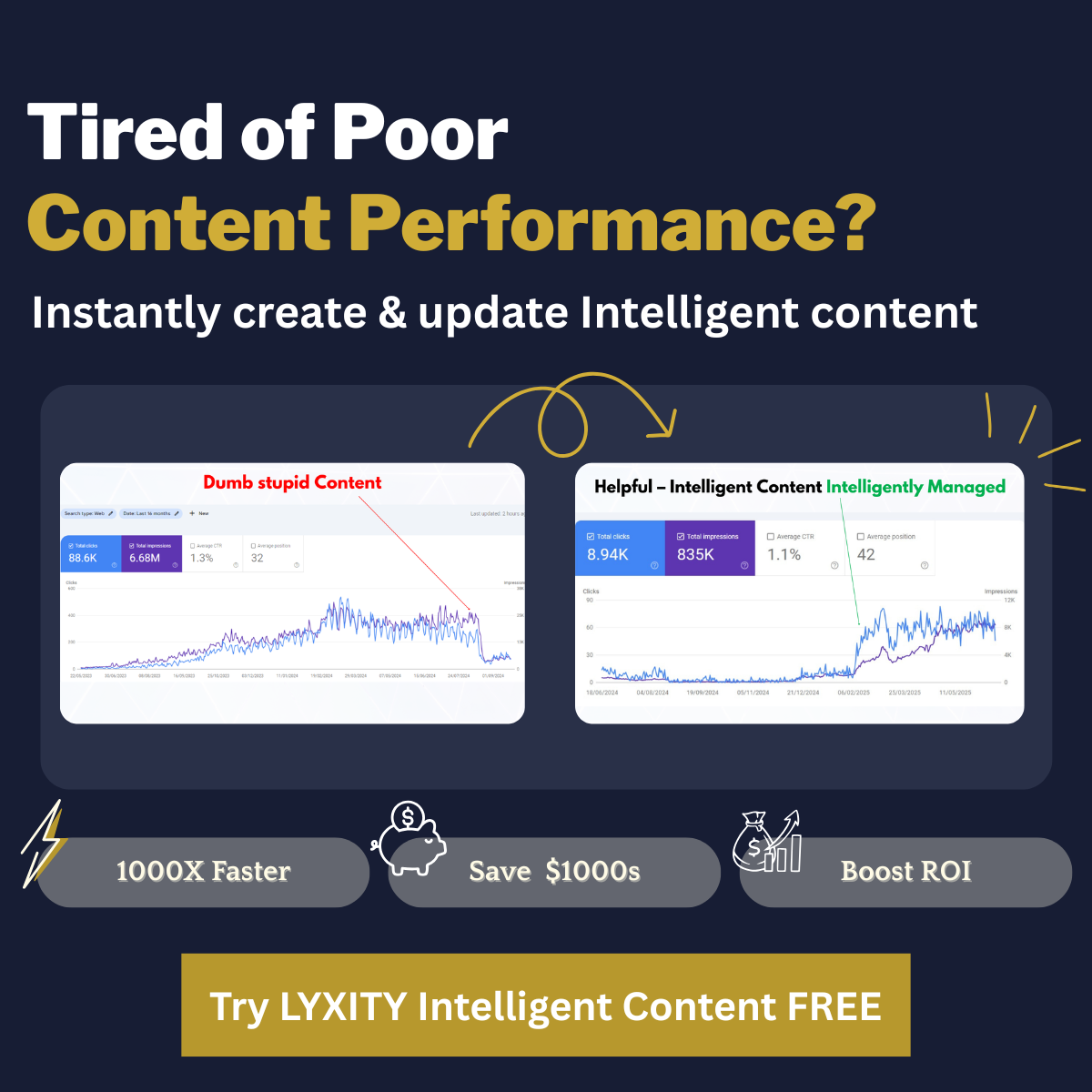
Improve pages that already receive impressions
Google Search Console can help identify pages that are already appearing for relevant searches.
These can be strong candidates for improvement.
Rather than immediately creating another article, consider whether an existing page can better answer the underlying question.
LYXITY connects to Google Search Console and can use live search information as part of the content-management process.
Keep pages accessible
For ChatGPT search specifically, OpenAI advises publishers not to block OAI-SearchBot if they want their content discoverable and cited in ChatGPT search results.
For Google, conventional crawling, indexing and people-first content principles continue to matter.
Frequently asked questions
Do AI search tools only mention highly authoritative websites?
No. Relevance to the question matters, and specialist sources can be useful.
Should every article target an AI search phrase?
No. Articles should address genuine customer questions.
Is structured data enough?
No. Structured data can help search systems understand certain information, but it cannot compensate for weak or irrelevant content.
Key takeaway
To improve the chances of your website being mentioned by AI:
Make individual pages genuinely useful for specific questions, then build enough connected subject coverage that the wider site makes sense as an expert resource.
LYXITY helps automate both sides of that process.
Get seen on AI. Get recommended. Get new customers.