Your website could be sitting on years of overlooked content
Think about how much money your business has spent creating website content over the past five years.
Articles.
Technical guides.
Product descriptions.
Industry news.
Service explanations.
Customer advice.
Now ask yourself one question.
When were those pages last reviewed?
For many businesses, the answer is uncomfortable.
Content gets published, briefly promoted and then forgotten.
Meanwhile, products change, industry requirements evolve, customer questions become more detailed and old information gradually loses its usefulness.
In 2026, improving legacy content deserves a prominent place in any serious SEO and AI-discoverability strategy.
What exactly is legacy website content?
Legacy content is information already published on your website.
It might be a technical article written six years ago.
It could be a product guide from last year.
It might be a useful explanation of an industry problem that has never been updated.
Legacy content is not necessarily bad content.
In fact, older articles can be among a website’s most valuable assets.
They may already attract relevant search impressions, have useful backlinks or provide specialist information that took considerable effort to produce.
The problem is that content quality can deteriorate when information is not maintained.
Why older content can create problems
Imagine a supplier publishes a detailed article about industrial heating systems in 2020.
At the time, the information was accurate.
Since then, the company has changed its product range.
Some technical specifications have been revised.
The article contains outdated links, and it doesn’t mention newer services.
A prospective customer who finds the article may receive an incomplete picture of what the company currently offers.
Search and AI systems encountering that information may face similar limitations.
Updating the article gives the company an opportunity to improve the usefulness and accuracy of its published knowledge.
The five areas to review in every legacy article
1. Factual accuracy
Check whether the information remains correct.
Review product details, statistics, technical standards, legislation and references to external organisations.
Use authoritative sources when updating consequential claims.
2. Contextual relevance
Does the article still address the questions customers ask?
Perhaps the market has changed.
Maybe customers now use different terminology or have new purchasing priorities.
Keep the original subject where it remains relevant, but strengthen explanations that are incomplete.
3. Content depth
Does the article give readers enough information to make progress?
An article that briefly describes five types of equipment may be more useful if it also explains their applications, limitations and selection criteria.
Additional content should resolve genuine information gaps.
Do not add paragraphs simply to increase word count.
4. Structure and readability
Review headings, subheadings, lists and the order in which information appears.
A reader should be able to locate the answer to a specific question without searching through irrelevant material.
Clear structure also supports accessibility and information retrieval.
5. Internal links and commercial relevance
An older article may not link to recently published guides, newer products or updated service pages.
Relevant internal links can help readers explore the subject and find the commercial information they need.
How LYXITY changes legacy-content management
For a small website containing 20 articles, manual reviews may be manageable.
For a business or digital agency responsible for hundreds or thousands of pages, the workload can become substantial.
LYXITY addresses this problem through intelligent content management.
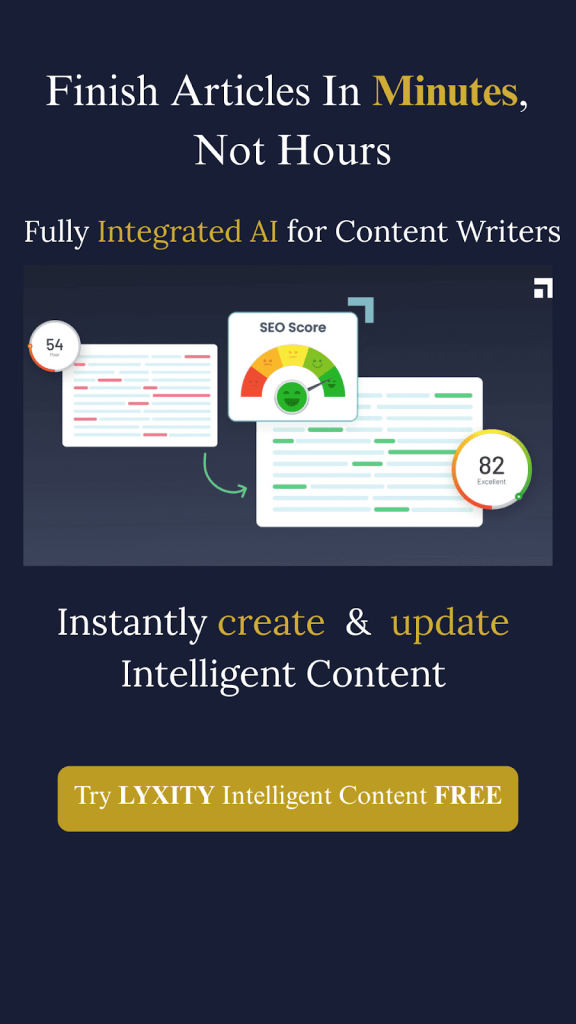
It can read existing website articles, enhance them with factual and contextual updates, expand relevant information and improve their structure.
It can also automatically add internal links, service-page links and CTAs.
This brings legacy-content improvement into the same workflow as new content creation.
The marketing team can then review important changes before publication.
A practical example: Refreshing an industrial product guide
Consider an engineering supplier with an older article titled:
“How to Select a Commercial Air Compressor.”
The original article contains a brief explanation of compressor types but little additional guidance.
A useful refresh could introduce:
- Application-specific equipment considerations.
- Relevant operating requirements.
- Maintenance and servicing considerations.
- Energy-efficiency information.
- Common specification mistakes.
- Appropriate technical references.
- Links to the company’s current compressor range.
- A clear next step for customers needing advice.
The improved article now provides greater practical value.
It also connects more effectively with the company’s wider body of technical and commercial information.
Should old articles always be expanded?
No.
Some articles need additional detail.
Others simply require factual corrections.
Some would benefit from combining overlapping content into one stronger page.
And a few may no longer have a legitimate purpose.
A good content strategy considers whether to retain, refresh, consolidate, redirect or remove each page.
Those decisions should account for existing rankings, backlinks, user value and technical consequences.
Automation should support that judgement, not replace it.
How updated content contributes to Topical Authority
A website demonstrates Topical Authority through the usefulness, credibility and breadth of its subject coverage.
Maintaining relevant articles helps ensure that the website’s existing knowledge remains dependable.
Combining refreshed legacy content with carefully selected new articles can create a more coherent and comprehensive information resource.
LYXITY makes that process easier by automating much of the writing, enhancement, structuring and linking work.
Frequently asked questions
Should I change the publication date when updating an article?
Only use dates that accurately reflect meaningful publication or revision activity. Changing a date without substantially updating the information can mislead readers.
Will updating an old article improve its Google ranking?
Not necessarily. Improvements depend on relevance, usefulness, competition and many other factors. Refreshing content should primarily make it more valuable to readers.
Is it better to update a page or publish a new article?
Update an existing page when the content serves substantially the same purpose. Publish a new article when the subject deserves a distinct answer.
Can LYXITY update legacy articles automatically?
Yes. Legacy-content improvement is one of LYXITY’s core capabilities. Businesses should still review material containing important technical, legal or commercial claims.
Key takeaways
- Old articles can remain valuable digital assets.
- Outdated information can reduce usefulness and credibility.
- Improve factual accuracy, relevance, depth and structure.
- Add links to related information and current services.
- Avoid expanding content simply to increase word count.
- Use LYXITY to automate substantial parts of the refresh process.
Before spending more money creating new content, make sure your existing content is doing its job.
LYXITY helps turn neglected content archives into actively maintained business assets.
Related reading: How to Get Seen by AI in 2026 (Pillar Guide) | How Internal Linking Helps AI Discover Your Website in 2026 | How to Get Your Website Recommended by AI in 2026